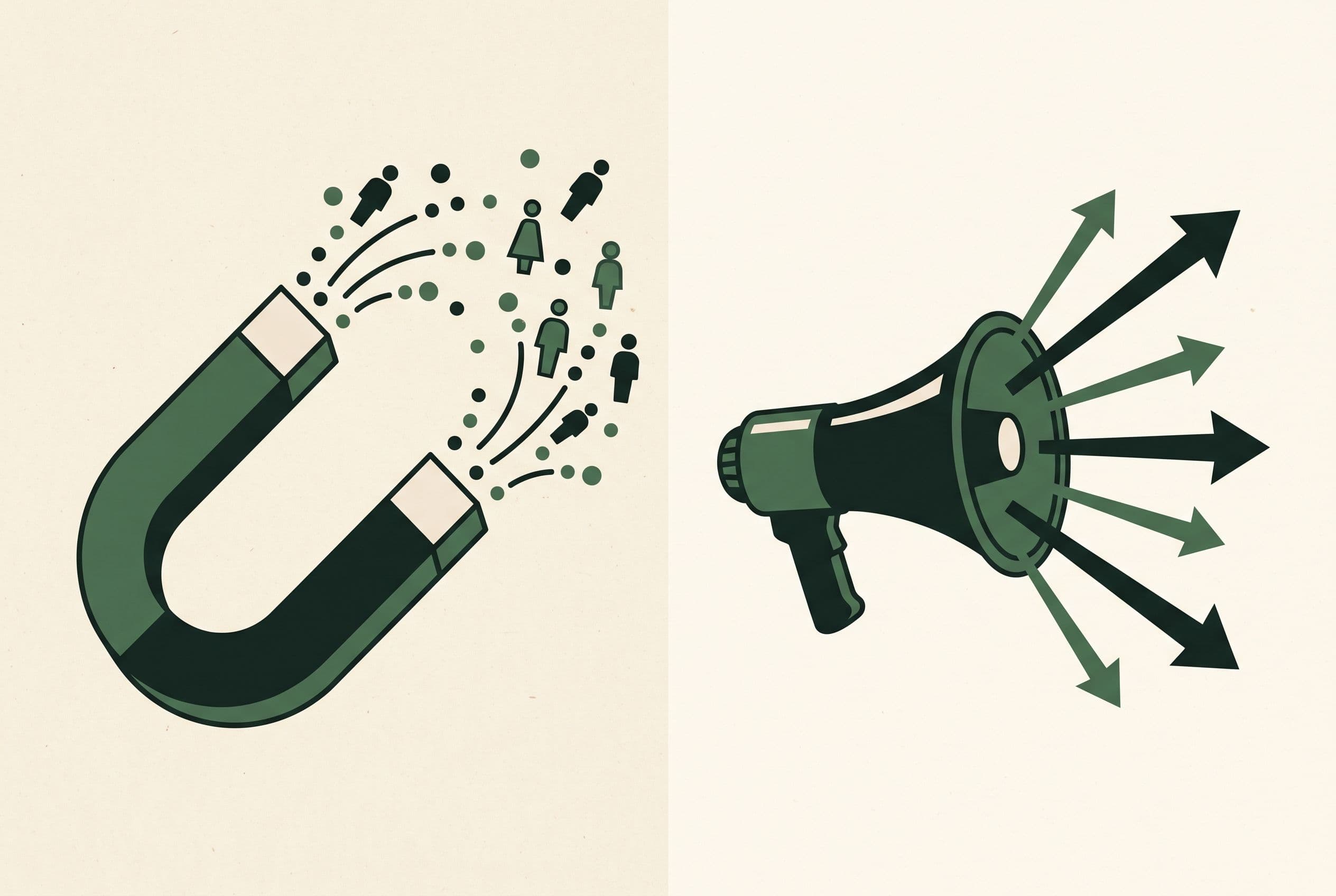
Inbound and outbound describe the two fundamental directions marketing can flow: pulling people toward you, or pushing your message out to them. Most of the tactical debates in marketing are really arguments about the balance between these two.
The core difference: pull vs push
Inbound marketing earns attention by being there when people are already looking — content, SEO, and resources that people find and come to on their own. It is a pull: the prospect initiates contact because you were useful or discoverable at the right moment.
Outbound marketing initiates contact itself — ads, cold outreach, and broadcasts that go out whether or not the recipient was looking. It is a push: you reach out to an audience rather than waiting for them to arrive.
How they behave differently
The two have opposite economics and rhythms. Inbound compounds slowly: content and search presence take time to build, then keep attracting people at little marginal cost. It tends to reach people with existing intent, which makes the traffic higher-converting but slower to scale.
Outbound works immediately and scales with spend: turn it up and reach grows now. But it targets people who weren't necessarily looking, so it usually converts at a lower rate and stops the moment you stop paying or sending. Speed and control on one side; durability and efficiency on the other.
Measuring each
Because outbound is initiated and paid, it is easy to measure per campaign — spend in, responses out — and its efficiency lives in metrics like cost per lead and cost per acquisition, which you can work through with the cost per lead calculator. The harder question is incrementality: how much it truly added versus what would have happened anyway.
Inbound is harder to attribute cleanly, because the path from a piece of content to a conversion is long and indirect. Its value shows up in compounding organic traffic and lower blended acquisition cost over time, which is why it's often undervalued by last-click reporting.
How to choose
Lean outbound when you need results now, are entering a market, or are targeting a specific, reachable audience. Lean inbound to build a durable, lower-cost engine for demand you'll want for years. In practice the strongest programs run both: outbound to capture and create demand today, inbound to make capturing it cheaper over time — and each feeds the other with audience and message insight.
The takeaway
Inbound pulls, outbound pushes. One compounds slowly and converts existing intent; the other scales immediately and creates awareness. The question is rarely which to pick and almost always what mix — fast reach now, durable attraction over time.