Research-based field guide · Updated July 17, 2026
The Sustainable Marketing Technology Stack for B2B Companies
A sustainable marketing technology stack is not a stack that stops changing. It is an architecture that can absorb change without repeatedly losing data definitions, controls, historical evidence, accessibility, or the ability to remove a tool safely. The model below is designed for B2B companies, but the same principles apply to B2C teams with higher-volume identity, transaction, and activation workloads.
The stack cannot be frozen
The State of Martech 2026 census mapped 15,505 products. The headline growth rate was only 0.79%, yet the underlying market remained active: 1,488 products were added and 1,367 were removed. A nearly flat total therefore concealed substantial churn.
The practical response is not to predict a permanent set of vendors. It is to preserve a stable spine while making edge components replaceable. Definitions, consent rules, records, experiments, and approval evidence should survive a vendor change. Channel tools should be adapters to that spine rather than the only place where institutional knowledge exists.
What “sustainable” means here
The W3C Web Sustainability Guidelines dated July 16, 2026 consider effects on planet, people, and prosperity. They also warn that digital-impact measurement contains data gaps and that partial improvements should not be presented as proof of total sustainability. The document is a Group Note Draft, not an endorsed W3C Recommendation, so it should be used as evolving guidance.
| Dimension | Working definition | Evidence to inspect |
|---|---|---|
| Environmental | Use proportionate data transfer, storage, computation, and hardware for the outcome being produced. | Page bytes, requests, job frequency, storage growth, software boundaries, supplier methods, and carbon-intensity calculations. |
| Operational | Remain understandable, observable, portable, maintainable, and removable as tools change. | Owners, schemas, exports, adapters, tests, incident history, renewal dates, migration drills, and decommission plans. |
| Human | Respect privacy, accessibility, autonomy, security, and accountable decision-making. | Purpose and retention records, user controls, approval logs, accessibility testing, AI oversight, and escalation paths. |
Human sustainability is not optional. The W3C Privacy Principles support data minimization and purpose limitation, while WCAG 2.2 provides the current W3C Recommendation for accessible web content.
Resource metrics are also not carbon claims by themselves. When a marketing-owned software boundary can be measured, ISO/IEC 21031:2024 and the open Software Carbon Intensity specification provide a method for expressing operational and embodied emissions per functional unit.
Where marketing-stack waste accumulates
Public-web evidence shows why third-party discipline matters. The 2025 HTTP Archive analysis found third parties on more than nine in ten pages and reported a median inclusion-chain depth of three. Its page-weight study measured median home pages of roughly 2.9 MB on desktop and 2.6 MB on mobile.
Those figures do not prove that a particular marketing stack is wasteful. They identify areas worth testing:
- multiple tags recording the same behavior with different names;
- data copied into tools without an owner, purpose, or expiration date;
- automations that continue running after a campaign or employee has left;
- point-to-point integrations whose failure cannot be isolated;
- heavy embeds, chat, personalization, or measurement code loaded before it is needed;
- dashboards that consume data but no longer change a decision; and
- vendor environmental claims that omit boundaries, allocation methods, or reporting periods.
A reference architecture: stable spine, replaceable edge
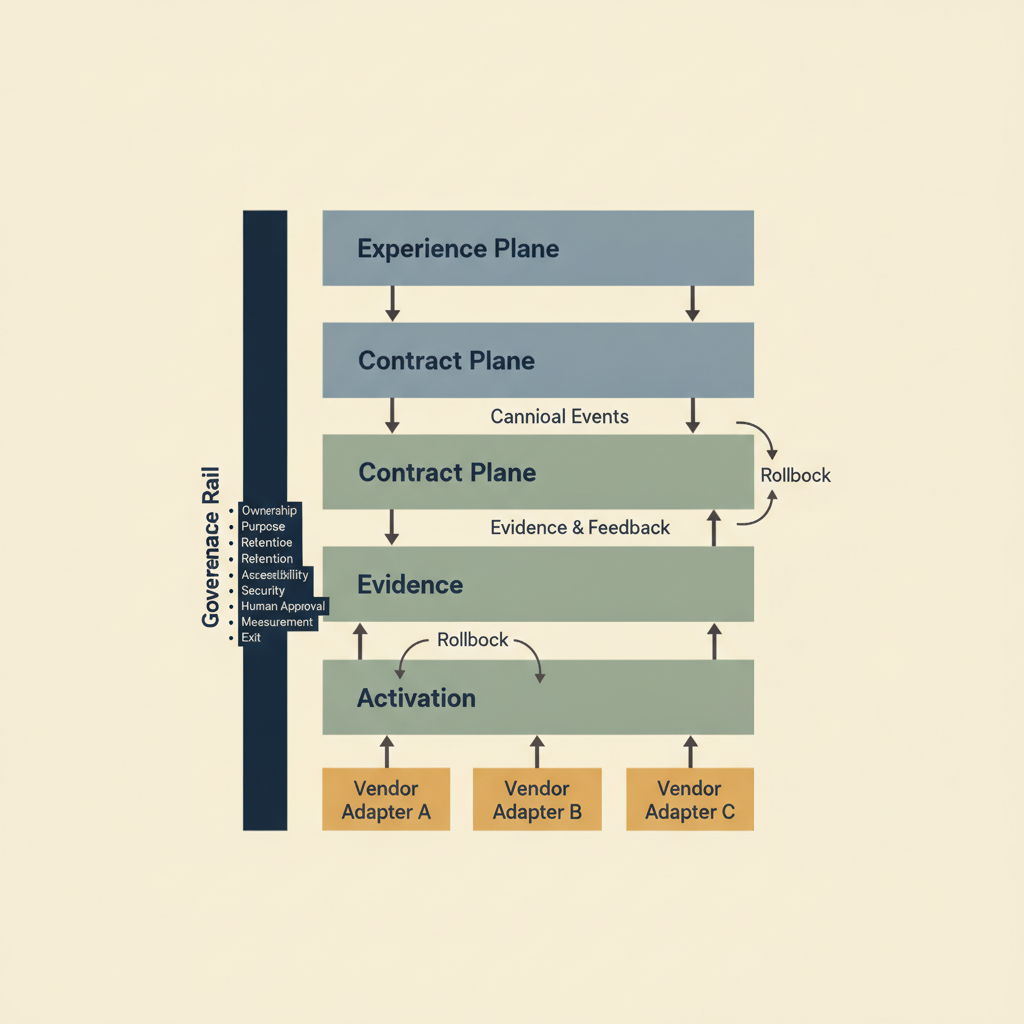
1. Experience plane
This plane contains owned sites, applications, messages, forms, commerce flows, events, and channel destinations. Instrument only events connected to a documented user need, decision, experiment, operational requirement, or reporting obligation. Load nonessential third parties after consent or interaction when feasible, and test the resulting experience for accessibility and performance.
2. Contract plane
Keep a canonical event dictionary outside any single activation vendor. Every important event should have a name, version, owner, purpose, source, allowed properties, retention rule, and change history. Vendor-specific fields can be produced by adapters without redefining the underlying business event.
{
  "event_name": "content_resource_requested",
  "schema_version": "1.2.0",
  "occurred_at": "2026-07-17T15:30:00Z",
  "subject_key": "pseudonymous-id-if-needed",
  "purpose": "measure_resource_interest",
  "consent_category": "analytics",
  "retention_days": 90,
  "source": "owned_web",
  "owner": "marketing_operations",
  "properties": {
    "resource_type": "guide",
    "campaign_id": "research-series"
  }
}
This is an educational artifact, not a universal legal schema. Consent terminology, identity handling, and retention periods must be reviewed for the actual jurisdiction and use case.
3. Evidence plane
Maintain durable records for customer or account state, event history, experiment designs, transformations, model versions, approvals, and resource measurements. Separate raw evidence from vendor dashboards. Apply lifecycle rules so obsolete logs, audiences, exports, and derived datasets are archived or removed deliberately rather than accumulating indefinitely.
4. Activation plane
Advertising, messaging, personalization, orchestration, analytics, and AI tools belong at the replaceable edge. Connect them through documented exports, APIs, queues, or transformation jobs. A replacement should require a new adapter—not a redefinition of every event and report.
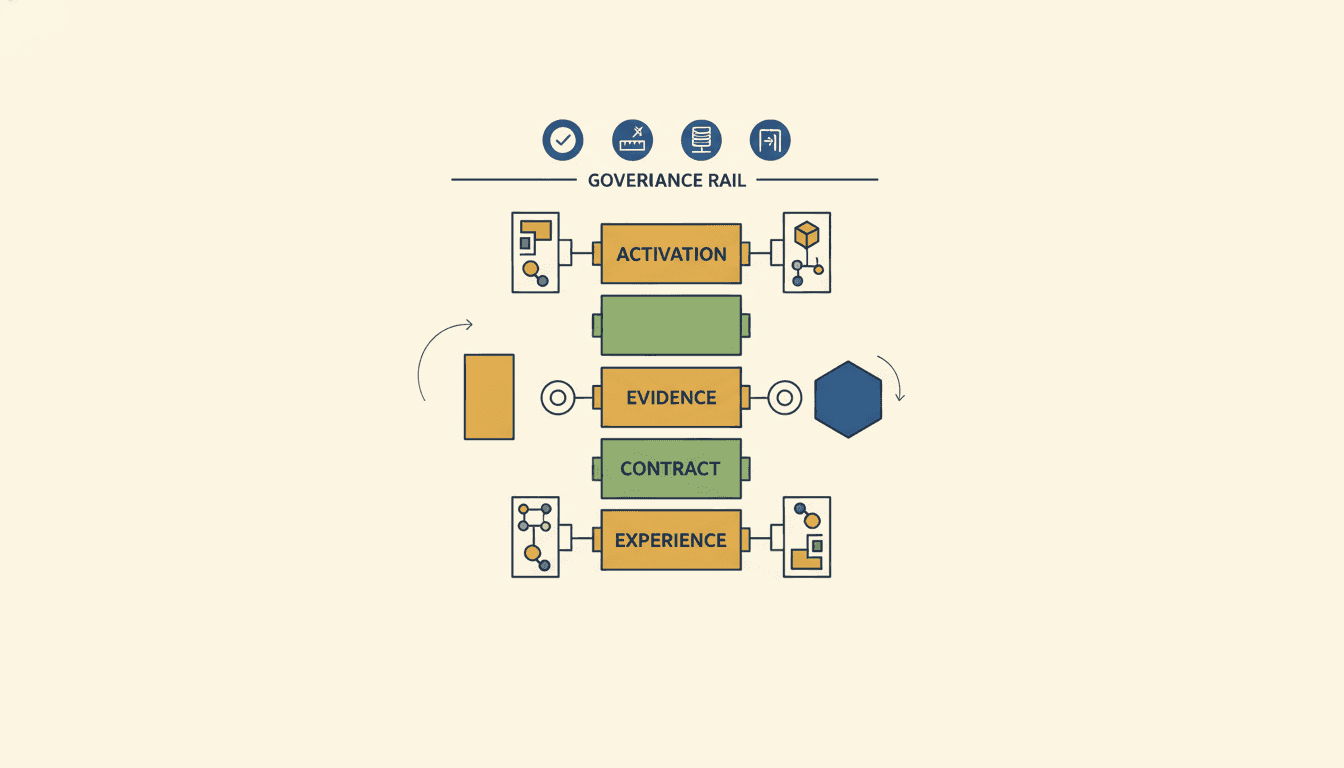
5. Governance rail
Run a governance rail across all four planes: named owners, access controls, renewal dates, data classifications, performance budgets, supplier evidence, human approval gates, incident procedures, and an exit plan. B2B teams may extend the spine with account, opportunity, and offline-conversion records. B2C teams may emphasize transaction, catalog, inventory, loyalty, and higher-volume identity flows. The architecture remains the same.
The original STACK sustainability test
The STACK test is an editorial decision aid for tools, integrations, datasets, and automations. It is not a certification. Score each dimension from zero to two: zero means absent, one means partial or untested, and two means documented and evidenced.
| Letter | Test | Question |
|---|---|---|
| S | Sufficiency | Does the component perform a defined job that changes a decision or delivers a necessary user outcome? |
| T | Transferability | Can data, configuration, definitions, and history move through documented, commonly usable formats or interfaces? |
| A | Accountability | Are the owner, purpose, access, retention, risks, approvals, and incident path explicit? |
| C | Cost of operation | Are financial, administrative, data, network, compute, storage, accessibility, security, and supplier impacts measured? |
| K | Killability | Can the component be paused, replaced, or removed without losing required evidence or creating uncontrolled failure? |
A suggested interpretation is 8–10 for retain and monitor, 5–7 for remediate or consolidate, and 0–4 for retirement or replacement review. Regardless of total, a zero in Accountability or Killability should trigger human review. These thresholds are deliberately conservative editorial heuristics and should be calibrated using the organization's risk and operating context.
Methodology
- Research cutoff: July 17, 2026.
- Source hierarchy: official standards, standards bodies, government guidance, primary specifications, public empirical datasets, and the original martech census were prioritized over vendor commentary.
- Scope: environmental, operational, privacy, accessibility, cybersecurity, procurement, and human-oversight evidence was synthesized. No product ranking was performed.
- Originality: the STACK test, event contract, three-ledger model, workflow, and diagrams are original editorial artifacts derived from the cited evidence.
- Governance: claims should be rechecked when standards or public datasets change. Publication and material updates require human approval under the site's editorial policy.
A practical 90-day workflow
Days 0–15: freeze and inventory
Pause nonurgent tool purchases and create one inventory covering software, scripts, integrations, datasets, models, automations, and reports. Record the owner, purpose, users, contract and renewal date, data received and sent, subprocessors or dependencies, access method, monthly job volume, retention behavior, failure impact, and export path. Mark unknown values rather than filling gaps with assumptions.
Days 16–30: baseline and score
Apply the STACK test. Measure representative website templates and workflows rather than relying on a homepage alone. Record transfer size, request count, third-party requests, scheduled jobs, storage growth, schema errors, accessibility findings, consent failures, reporting latency, and the number of decisions each report supports. Map every critical event from collection through transformation, storage, activation, and deletion.
Days 31–60: stabilize the spine
Create or repair the canonical event dictionary. Assign owners and retention rules. Put vendor transformations in adapters. Remove duplicate collection where evidence supports removal, and load optional experiences only when needed. Correct accessibility, privacy, and security defects before describing a reduction as sustainable; fewer bytes do not justify excluding users or weakening controls.
Days 61–90: run reversible reduction tests
- Choose a low-risk duplicate tool, tag, audience sync, report, or scheduled job.
- Write a hypothesis, primary business metric, resource metric, human-safety guardrails, observation period, and rollback condition.
- Pause or route a controlled subset rather than deleting immediately.
- Observe at least one relevant business cycle. Low-volume B2B funnels may require longer than high-volume B2C flows.
- Retain, remediate, replace, or retire based on recorded evidence. Preserve required history and obtain human approval before permanent deletion.
Repeat the review quarterly and before major renewals. Require a STACK score and named owner for each new acquisition so that the inventory does not immediately become obsolete.
Measure three ledgers, not one dashboard
| Ledger | Example measures | Decision supported |
|---|---|---|
| Business | Qualified demand, purchase or pipeline conversion, experiment lift, decision latency, customer-service effects, and reporting use. | Whether the capability produces sufficient value. |
| System | Tool and integration count, owner coverage, schema violations, duplicated events, incidents, renewal exposure, export success, and migration-test results. | Whether the stack remains understandable and changeable. |
| Resource and human | Bytes, requests, jobs, storage, retention volume, accessibility defects, consent exceptions, approval overrides, and substantiated supplier evidence. | Whether the outcome is proportionate and responsibly governed. |
For a measurable marketing-owned software boundary, the SCI method can express emissions per functional unit—for example, per completed campaign workflow or another unit that accurately describes scaling. Disclose the boundary, period, telemetry or model, carbon-intensity source, embodied-emissions treatment, and exclusions.
Purchased software and services may also contribute to value-chain accounting. The GHG Protocol Scope 3 calculation guidance supports supplier-specific data where available and secondary or spend-based methods when it is not. Keep those methods visibly separate. A vendor's corporate total, renewable-energy statement, or offset claim is not automatically a comparable product-level footprint.
Procurement questions that support durability
Marketing, technology, security, procurement, accessibility, privacy, and sustainability reviewers should use a shared questionnaire. The NIST supply-chain risk guide supports defining and communicating supplier requirements.
- What data, configuration, logs, models, and consent records can be exported, and in which formats?
- How are deletion, retention changes, and revoked permissions propagated through primary systems, backups, caches, and subprocessors?
- Which third parties and infrastructure dependencies are required to deliver the service?
- What accessibility evidence covers the actual interfaces and workflows being purchased?
- What security maintenance, incident notification, recovery, and end-of-life commitments are contractual?
- For AI features, which data is used for training, tuning, evaluation, retrieval, or human review?
- For environmental claims, what are the boundary, functional unit, allocation method, reporting period, location method, embodied-hardware treatment, exclusions, and assurance status?
- What happens operationally and financially when the customer exits?
Human-in-the-loop safety
The NIST AI RMF Core calls for documented human-AI roles, defined oversight, continuing monitoring, safe decommissioning, and contingency processes for third-party failures. In marketing operations, human review should be placed at decisions with meaningful financial, reputational, privacy, accessibility, or customer impact.
- Do not allow AI or automation to publish public claims, creative, or sustainability statements without human approval.
- Require approval for material budget, bid, audience, suppression, frequency, or channel changes above documented thresholds.
- Require enhanced review before using sensitive data, resolving identities, creating consequential classifications, or combining data for a new purpose.
- Use two-person approval for irreversible deletion, large exports, high-impact model changes, and final decommissioning.
- Maintain an audit record containing the input, model or rule version, proposed action, reviewer, decision, time, exceptions, and rollback path.
- Provide a tested pause mechanism for autonomous jobs and preserve a non-AI operating path for critical communications.
Human oversight is not a ceremonial click. Reviewers need enough context, authority, time, and evidence to reject the proposed action. Sampling may be appropriate for low-risk repetitive tasks, but the sampling rule and escalation threshold should themselves be approved and tested.
Limitations
- Stack sustainability is narrower than organizational sustainability and does not establish a complete greenhouse-gas inventory.
- HTTP Archive measurements characterize public web pages, not every application, data platform, mobile experience, or private B2B workflow.
- Tenant-level SaaS energy and hardware data may be unavailable. Estimates should disclose uncertainty and should not be used for vendor comparisons without compatible boundaries.
- The STACK thresholds are an original heuristic. Validate them through public experiments or internal controlled tests rather than presenting them as a standard.
- Privacy, accessibility, cybersecurity, environmental-accounting, and record-retention obligations vary. Review the site's privacy information and accessibility statement, then obtain qualified review for the actual deployment.
- The W3C sustainability guidance is a draft, and NIST states that AI RMF 1.0 is being revised. Recheck both before codifying policy.
- Do not remove redundancy that is necessary for security, recovery, availability, accessibility, or legal preservation merely to reduce a resource metric.
The operating principle
A durable stack has a small, governed spine and a replaceable edge. It collects less but better-defined data, preserves evidence outside channel tools, measures outcomes and resource use together, and treats exitability as a feature rather than a future migration problem.
Related independent writing and artifacts are published for self-directed learning. No tool, vendor, or service is being solicited or promoted here.